

The most reliable way to get SEO clients without cold calling is to pitch specific businesses with evidence. Pick a niche and an area, find businesses with visible search gaps, and send each one a short page showing two or three things you found, ideas they can pick from and a starting price. Follow up twice, then let slower channels (case studies, a niche landing page, partners and referrals) build up alongside it.
Below: the method step by step, the first message to send, how to price the first job and a weekly routine that fits around client work.
Why evidence works better than cold calling
Business owners get a steady stream of SEO calls and emails, and most of them say the same thing. Google's own guide to hiring an SEO tells owners to be wary of firms that email them out of the blue, and states that "no one can guarantee a #1 ranking on Google."
So your outreach has to be the opposite of what they've been warned about:
- Specific: about their business, not "your website".
- Checkable: they can confirm what you found in under a minute.
- Honest: you commit to work and reporting, not to positions.
- Easy to ignore: no call they didn't ask for, and a clear way to say no.
A phone call interrupts. A page with screenshots of their own listing can be read when they're ready, forwarded to a business partner and answered in one reply.
How to get SEO clients in five steps
1. Pick a niche and an area
A niche makes every later step faster: you learn what customers search for, which competitors keep appearing and which fixes work. "Dental practices around Dallas" or "independent physiotherapy clinics in Manchester" is a niche. "Small businesses" isn't.
Good SEO niches tend to share four traits:
- A new customer is worth a lot. An implant patient, a boiler installation or a new legal client can cover months of SEO work.
- People search when they need it. They type the service and a town into Google, often on a phone.
- They already spend on marketing. Ads, an active social account or a recent website suggest a budget.
- You can reach the person who decides. Owner-run firms decide quickly; branches of national chains often can't.
Choose an area you can get to know: a city or a region, not a whole country.
2. Find businesses with visible SEO gaps
Search the way their customers would, with "[service] in [town]" and "[service] near me", in a private browser window while you're in or near that town. Look at the map results and the first two pages. Businesses just outside the top three on the map, or on page two, are your best prospects: visible enough to matter and close enough to improve.
Then check each one for gaps you can see from the outside:
| Gap | How to check | Why the owner cares |
|---|---|---|
| Incomplete Google Business Profile | Open their profile from Google Maps and look at categories, hours, services and photos | Google says inaccurate details can stop a profile showing for relevant local searches |
| Unanswered reviews | Read the last 10 reviews and any replies | People read the replies before they call; Google says replying shows you value feedback |
| A slow or thin site | Test the home page and a main service page in Google's PageSpeed Insights on mobile, and see whether service pages run past a paragraph | A slow page loses people before they find the phone number, and a one-paragraph page rarely answers a searcher's question |
| Missing service or location pages | Compare the services and towns they list with the pages on their site | It's hard to rank for "[service] in [town]" without a page about it |
| Not showing for their main search | Search their main service and town in a private window | This is the gap you're really selling |
| Business details that don't match | Compare name, address and phone on Google, Yelp, Apple Maps and Bing Places | Mismatches confuse customers and send calls to old numbers |
The Google points in the table come from its tips to improve your local ranking.
Skip businesses that already lead the map with strong reviews (unless they have several locations), look closed, or give you no way to reach the owner.
3. Note two or three findings per business
Two or three findings is enough. More than that turns a pitch into an audit nobody asked for. Each finding should be true today, specific to that business and phrased as what a customer sees, not as a fault.
Example notes for a fictional practice, Cedar Grove Dental in Plano, Texas:
- When you search "dentist Plano" on a phone, Cedar Grove isn't in the map results, but two practices further away are.
- The Google profile shows Saturday opening hours; the website says Saturday clinics stopped in the spring.
- Nine of the last twelve reviews have no reply, including two that mention waiting times.
Give each business 10 to 15 minutes. If you can't find two real findings in that time, move on. There's more on leading with one observation in our guide on how to pitch your services.
4. Send a short page made for them
Keep the email short and put the detail on a page made for that one business. The page needs five parts:
| Part | What to put |
|---|---|
| What you noticed | Your two or three findings, with screenshots |
| Why now | What makes it timely: a new branch, a busy season, a competitor moving up |
| Ideas to pick from | Two or three fixes, smallest first, such as a profile clean-up, new service pages and a routine for replying to reviews |
| A starting offer | One fixed price for the first step, with the bigger ideas priced "from" |
| One next step | Reply, book a short call or ask a question |
The local SEO pitch template is laid out this way, and there are more by industry in our pitch templates.
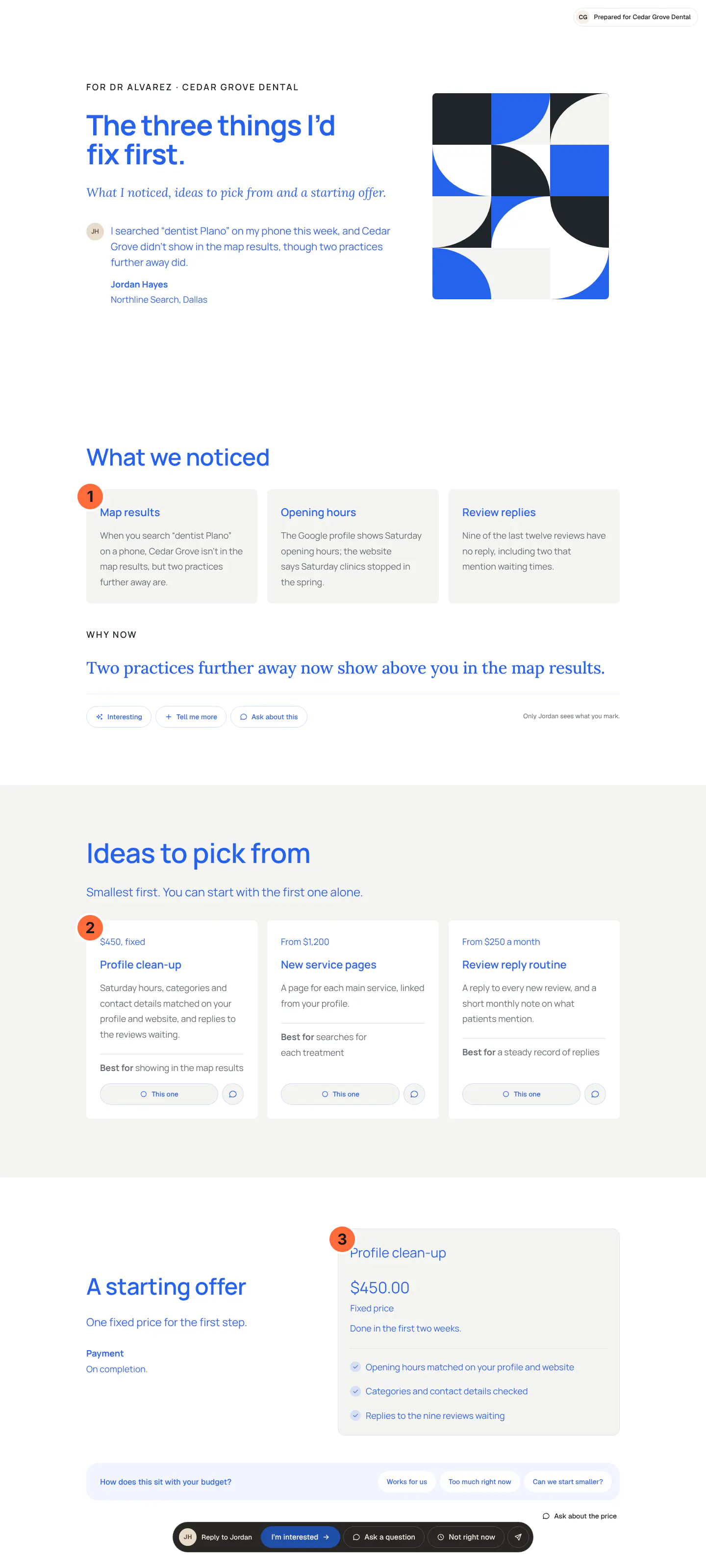
- What you noticed: three findings the owner can check in a minute
- Ideas to pick from, smallest first
- A starting offer: one fixed price for the first step
5. Follow up twice, then stop
Send the first follow-up three or four days later and the second about a week after that. Add something new each time: another finding, a competitor that has moved up, or a short answer to a question they're likely to have. After the second, stop. Note a date to check again in a few months and move on. Our follow-up email guide has wording for both.
What to say in the first message
The first message has one job: to get them to open the page. Five rules:
- The subject line is about them.
- The first sentence is your finding.
- There's one link and no attachments.
- Saying no is easy.
- It's signed by a person, with a town.
Here's an example for Cedar Grove Dental:
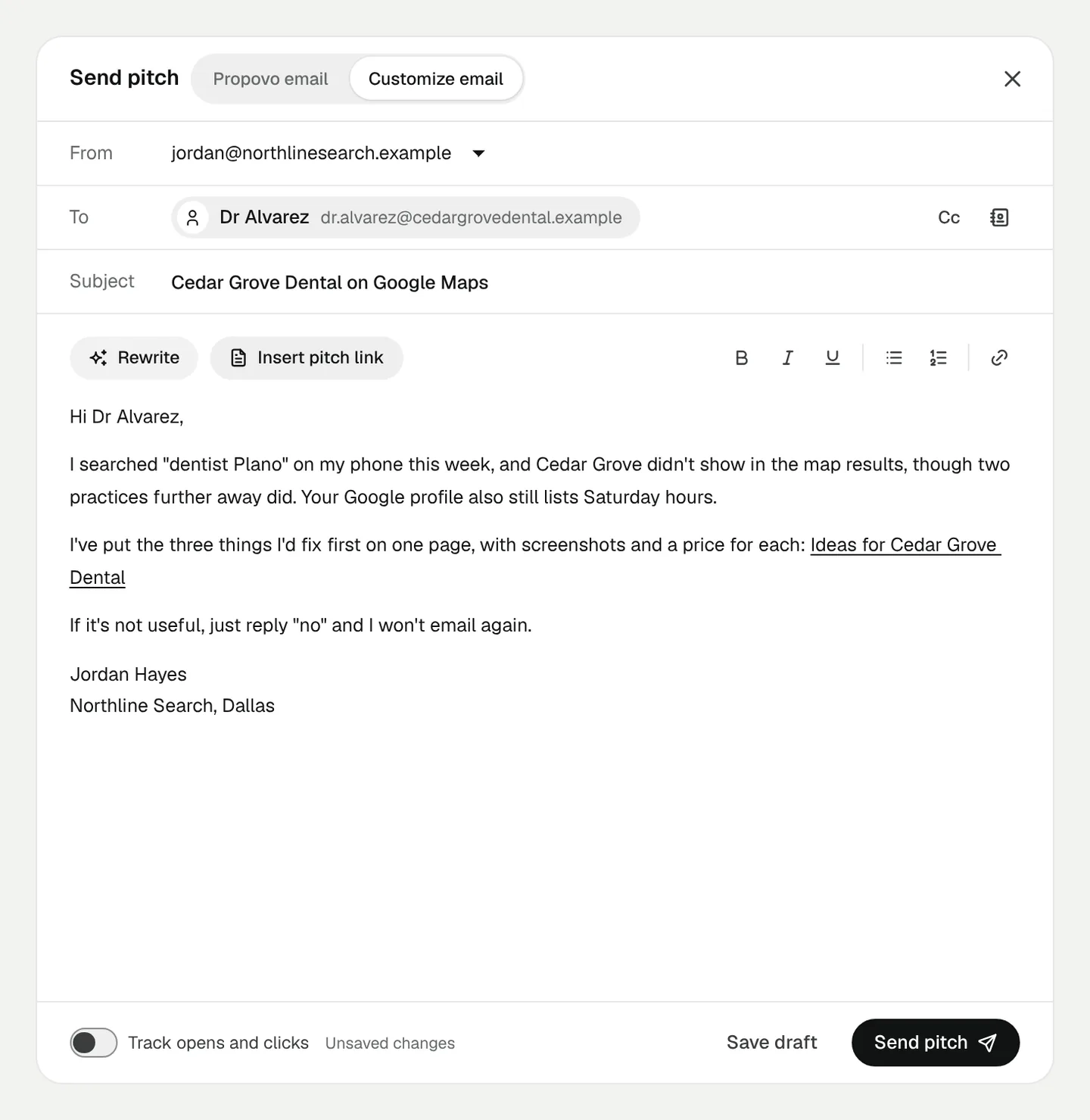
Subject: Cedar Grove Dental on Google Maps
Hi Dr Alvarez,
I searched "dentist Plano" on my phone this week, and Cedar Grove didn't show in the map results, though two practices further away did. Your Google profile also still lists Saturday hours.
I've put the three things I'd fix first on one page, with screenshots and a price for each: [pitch link]
If it's not useful, just reply "no" and I won't email again.
Jordan Hayes
Northline Search, Dallas
For other openings, such as a new location, a hiring push or an old lead, see our cold pitch email templates. Rules on unsolicited business email differ between the US, the UK and EU countries, so check what applies where you're sending.
How to price a first SEO engagement
A first engagement should be small enough to say yes to and concrete enough to show how you work. Four shapes work well:
| Offer | What's included | Why it works as a first step | What usually follows |
|---|---|---|---|
| Fixed-fee audit | A review of their profile, site, listings and competitors, with a ranked list of fixes | Low risk, and they keep the list whatever happens | You carry out the fixes, or a sprint |
| Fixed-scope setup | A profile clean-up, two or three service or location pages and a review reply routine | Visible work within weeks | A monthly retainer |
| 90-day sprint | Set deliverables each month, a monthly report and a review at day 90 | Time to ship work and see early movement | A retainer if the review goes well |
| Monthly retainer | Ongoing content, local work and reporting | Suits clients who have already seen your work | Renewal, or more locations |
To set the number, estimate the hours, multiply by your rate, add a margin for the unexpected and quote one fixed fee. Show one starting price on the pitch and price the bigger ideas "from". If the client says the price is too much right now, offer the smallest piece on its own rather than discounting everything. You can also credit an audit fee against the first month of a retainer if they go ahead, which makes the audit easier to approve.
Never tie the price to ranking positions. Price the work and the reporting.
When the first job turns into something bigger, send a full proposal. Our SEO proposal template guide walks through one, and the SEO growth retainer template is ready to edit.
How to find local SEO clients
Local SEO clients are the easiest to find with evidence, because nearly everything you need is public: their map listing, their reviews and how they compare with the businesses around them.
Where to look:
- Map results by neighbourhood. Search the same service across several districts. A business that appears in one and disappears in the next has a gap you can show them.
- Local ads. A business paying for ads above the results but missing from the map below already spends money on search.
- Businesses with several locations. Each branch has its own profile, so the gaps multiply, and so does the work. Dental groups, gyms, car services and restaurant groups are common examples.
- Directories and associations. Chambers of commerce, trade associations and industry directories list businesses by area and sector.
- Trigger events. A new branch, a move, a rebrand or a new website with old pages now broken gives you a reason to write this week.
What to check that's specific to local search: primary and secondary categories, opening hours (including holiday hours), photos, duplicate listings, review replies, matching name, address and phone everywhere, and a page on their site for each location and main service.
Meeting owners at local business groups and chamber events still works. Bring one finding about their business rather than a brochure.
Slower channels that build over time
Pitching brings the first clients. These channels take months to build, but they bring work you don't have to chase.
Case studies with real numbers
After each engagement, write up the problem, what you did, what changed and over what period, with the client's permission. Two or three in your niche do more than a row of logos.
A niche landing page
A page such as "SEO for dental practices in Dallas" shows you can do what you sell. It can rank for searches from your niche, and every pitch can link to it for credibility.
Partners: web designers and other agencies
Web designers, ad agencies and PR firms get asked about SEO and often don't want to do it. Offer them a referral fee or white-label delivery, and pitch them the way you'd pitch a client: what you noticed about their clients' sites and how you'd help.
Referrals
Ask when the client can see a result, not at the end of the year. Make it easy with a two-line description of what you do and who you help, which they can forward.
Communities and directories
Answer questions where owners in your niche gather, such as trade groups and LinkedIn, without pitching, and keep your agency directory profiles up to date. Neither brings work quickly, but both make you easy to check when a pitch lands.
A weekly routine that fits around client work
Ten businesses a week is enough to learn what works without taking over your week.
| Day | Task | Output |
|---|---|---|
| Monday | Find 10 businesses in your niche and area | A list with links |
| Tuesday | Note two or three findings for each, with screenshots | 10 sets of notes |
| Wednesday | Build and send 10 pitch pages | 10 pitches sent |
| Thursday | Send the follow-ups that are due, answer replies and take calls | Follow-ups sent, calls booked |
| Friday | One slower-channel task, such as a case study, a landing page update or a partner call, then review the week | Numbers updated |
Track six numbers: researched, sent, opened, replied, calls and won. When replies are steady, raise the weekly number. If pitches get opened but nobody replies, change the findings or the offer, not the volume.
Mistakes that cost SEO clients
- Generic audits. A 40-page automated report full of scores tells the owner you didn't look. Two findings about their business beat 200 warnings that could apply to anyone.
- Ranking guarantees. Nobody controls Google's results, and Google tells business owners exactly that. Informed buyers read a guarantee as a warning sign, and the buyers it does attract will hold you to it. Commit to the work and to how you'll report on it.
- Spam. The same email to hundreds of businesses, made-up "I was browsing your site" lines, bought lists and endless follow-ups all teach owners to ignore SEO outreach, including yours.
- Criticising their current provider. Point out what customers see. Who built it doesn't matter.
- Pitching everyone. Without a niche and an area, each pitch takes longer and none of them build on each other.
How Propovo helps you pitch SEO clients
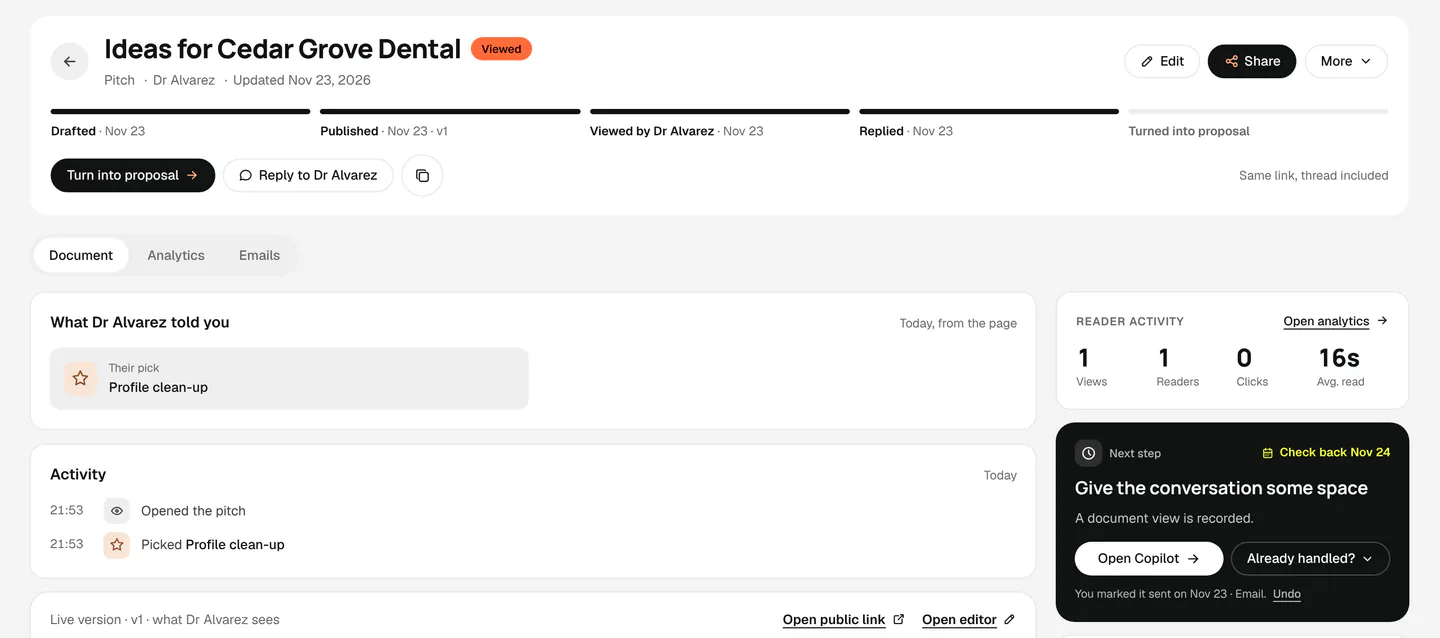
Propovo's pitch pages handle step 4. Paste the business's website, say why you thought of them, and Propovo drafts a pitch from your business profile and services, with a note on why now, ideas they can pick from and prices from your services. You edit it before anything goes out.
The business can pick an idea, check your price against their budget or reply in one tap. You get alerts when they open the pitch and which idea they pick. If the timing is wrong, they choose a date to hear from you again and Propovo reminds you. When they say yes, the pitch becomes a proposal at the same link. To pitch several businesses in one go, run them as a campaign.
Frequently asked questions
How do I get my first SEO client with no case studies?
Pitch with evidence instead of past results: two or three findings about their business show what you'd do. Offer a small fixed-price first step, then turn that work into your first case study.
Should I offer free SEO audits?
A full free audit gives the work away and is easy to ignore. Two or three free findings in a pitch, with a paid audit or setup as the first step, show the same expertise and lead somewhere.
How many businesses should I pitch each week?
Ten well-researched pitches a week is a sensible start for a freelancer or small agency. Raise the number once you know which findings and offers get replies.
Can I guarantee SEO rankings?
No. Nobody controls Google's results, and Google's own advice tells business owners to be wary of anyone who promises a top ranking. Commit to the work, the timeline and how you'll report on progress.
Which businesses make the best local SEO clients?
Businesses where one new customer is worth a lot and people search with a town name, such as dentists, physiotherapists, law firms, trades and businesses with several branches. Look for ones that already spend on marketing but don't show in the map results.
How do I get SEO clients for my digital marketing agency?
Start with the clients you already have for web design, ads or social media, since they know your work. Then partner with web designers who don't offer SEO, and use the pitching method above in one niche.
Sources
- Google Search Central: Do you need an SEO?
- Google Business Profile Help: Tips to improve your local ranking on Google