
Shopify Store Build Proposal
Shopify store build proposal with a six-week timeline, team training and three fixed-price options.
Free for 14 days. No card required.
Make this template yours
A clear structure
A starting point for the scope, pricing and next steps you want to share
Ready to edit
Keep useful sections and replace the content with your client details
Your brand
Choose the colors, fonts and imagery that fit your business
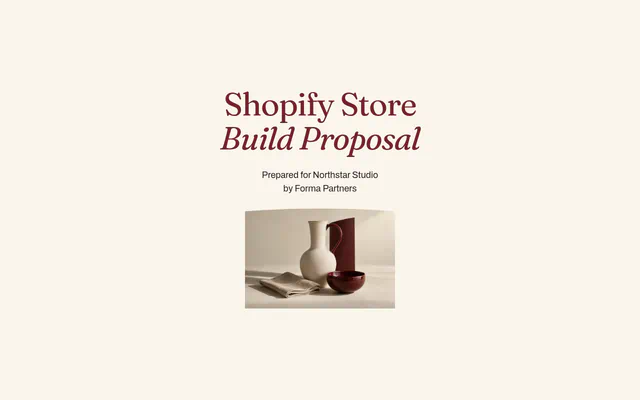
About this template
This Shopify proposal template covers a one-off store build: catalogue and customer journey planning, theme, product and checkout configuration, order testing and merchant training. It is for ecommerce agencies and freelance Shopify developers asking a client to approve a defined first release, a six-week launch plan and a fixed project price.
Who this template is for
Use it for an ecommerce website proposal where the client sells a known range of products into an agreed market and wants a store their team can run. It focuses on configuring Shopify well rather than custom app development, and the client keeps the store account and product data.
What each section covers
- Introduction
- A letter stating what the first release covers and that the client keeps control of the store.
- Shopping Journey
- Three stages, browse, consider and purchase, plus a review of the mobile experience.
- Build Scope
- Storefront, catalogue, commerce settings, measurement and handover, with product and collection counts to fill in and a note on what is separate.
- Merchant Handover
- A practice-before-launch checklist and what the client receives at handover.
- Client Perspective
- Placeholders for an approved client quote and a verified outcome.
- Launch Plan, Pricing and Next Steps
- A six-week timeline, a launch review checklist, a three-line quote table and the workshop that follows acceptance.
How to price a Shopify store build
The template prices the build as one project in three lines: planning, configuration, and testing with training. It is invoiced on approval, with milestones confirmed in the engagement agreement. A clear product and collection count gives the price a firm boundary.
List running costs separately: Shopify subscriptions, theme licences and paid apps belong to the client. Photography and custom app development are excluded, so quote them on their own if needed.
Before you send it
- Fill in the counts
- Set the number of products and collections you will load, from data the client supplies.
- Check the Shopify plan
- Checkout customisation depends on the client’s plan. Confirm it before promising changes.
- Agree the launch test
- Make a test purchase and refund part of launch approval, as the template does.
- Plan the domain cutover
- Agree who moves the domain and when.
What’s in the Shopify Store Build Proposal
9 parts, in the order your client reads them. Every part is editable: keep what fits the job, rewrite the rest and add your own.
Introduction
You want a store of your own, so repeat customers buy from you directly and Etsy stops taking a cut of every order.
How customers will shop
Seven in ten of your Etsy visitors use a phone, so every page is designed for a phone first.
What we build
Everything in the recommended option, Launch and move from Etsy.
Who you will work with
Thirty-four Shopify stores built for makers and small brands since 2019, most of them moving from Etsy or a marketplace.
Covers: Your team practises before launch
Results for a similar client
A glassware maker that moved from Etsy to its own store.
Covers: The client, The result
Timeline
Collections, page list and the look of the store agreed in one workshop.
Covers: Before we launch
Options and fees
Three fixed-price options. We recommend Launch and move from Etsy.
Questions
Not at launch. Most makers keep Etsy for new customers and send repeat customers to their own store.
Next steps
Pick an option and any extras, then accept on this page.
Frequently Asked Questions
What should a Shopify store proposal include?
The products and collections in scope, theme and page templates, payment, shipping and tax settings, analytics, a launch plan with testing, handover and training, exclusions such as apps and theme licences, and a price with payment terms.
How do I write an ecommerce website proposal?
Start with how the client’s customers find and buy products, define the catalogue size and store settings you will configure, set a launch checklist, and separate one-off build fees from running costs the client pays to Shopify and app vendors.
Who owns the Shopify store after the build?
The client should. This template keeps the store account, app accounts and product data in the client’s name and hands over a configured theme, a product-management guide and a recorded walkthrough.
Are Shopify fees and apps included in the build price?
Not in this template. Shopify subscriptions, theme licences and paid apps are excluded and paid by the client. Photography and custom app development are also separate, so quote them on their own if needed.



Ready to make it yours?
Add your scope, pricing and brand. Preview the client experience before sharing.