
SaaS Renewal and Value Review Proposal
SaaS renewal proposal with a usage and value review, right-sized seats and one, two or three-year terms.
Start free. No card required.
Make this template yours
A clear structure
A starting point for the scope, pricing and next steps you want to share
Ready to edit
Keep useful pages and replace the content with your client details
Your brand
Choose the colors, fonts and imagery that fit your business
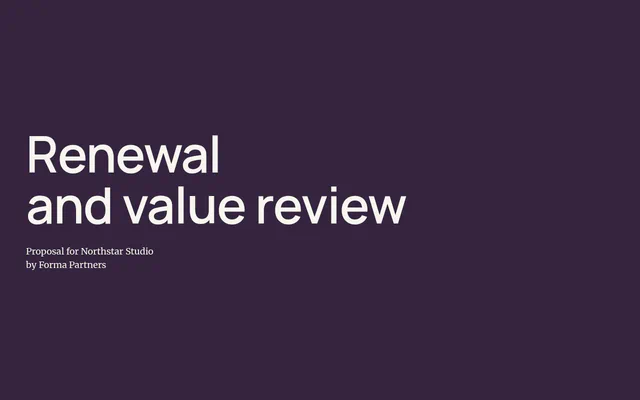
About this template
A SaaS renewal proposal reviews a customer’s first year before asking them to renew: how the software was used, the value it delivered and how that was worked out, and what changes for the next term. This template recommends dropping unused seats, sets out contract terms such as price protection, and offers terms of one, two or three years.
Who this template is for
Account managers and customer success teams at software companies preparing a renewal, especially when seats are unused, a price rise is due or you want to offer a multi-year term. It is written for the customer’s budget holder, who has to justify the renewal internally.
How to price a renewal
Show the next term’s price next to what changes, line by line, and reward a longer commitment with a lower yearly price and price protection. Recommending fewer seats can look like lost revenue, but it builds trust and makes the renewal easier to approve.
State the contract terms plainly: how seats can be added mid-term, how billing works and what happens to the price at the next renewal. Surprises at invoice time are what turn a renewal into a competitive review.
Before you send it
- Check the usage numbers
- Use seat and feature use from your own product data, by team, and say where each number comes from.
- Show how value was worked out
- Explain the method behind each value figure, such as hours saved multiplied by an agreed hourly cost, so the customer can repeat it.
- Match the terms to your policy
- Confirm the discounts and price protection your company allows for each term length.
- Send it early
- Send the proposal well before the renewal date, so the customer has time for internal approval.
Who it’s for
- SaaS account managers and customer success teams
- Renewals with unused seats or a price rise
- Multi-year renewal offers
What makes it work
- Usage and value numbers with their sources
- Seat use by team chart
- What changes at renewal, line by line
- Contract terms: adding seats, price protection, billing
- One, two or three-year terms, with extras
Time to customise: about 20–30 minutes.
What’s in the SaaS Renewal and Value Review Proposal
10 parts, in the order your client reads them. Every part is editable: keep what fits the job, rewrite the rest and add your own.
Introduction
In short: 82 people use it every week, requests are answered in hours rather than days, and 11 seats have never been used.
Your first year
From your admin reports for the 90 days to 29 October.
Covers: Where seats are used, and where they are not
Our recommendation
You stop paying for seats nobody uses, and the price rise on 1 January does not apply to you until 2028.
What is included
For the recommended two-year term. The other terms differ only in length and price.
Covers: Contract terms
Timeline
Nothing changes for your users on the renewal date.
Your team
The same people as this year, with a solutions engineer for the operations work.
Covers: Account manager
Results for a similar customer
A clinic group that reviewed its seats before renewing.
Covers: The customer, The result
Renewal options
Three terms for 95 seats. We recommend two years.
Questions
Your subscription renews for one year at 100 seats and the new list price of $30 a seat, which is $36,000.
Next steps
Pick a term and any extras on this page, then accept.
Frequently Asked Questions
When should you send a SaaS renewal proposal?
Well before the renewal date: early enough for the customer’s budget and approval process. Larger accounts often need a review meeting first.
Should you recommend fewer seats at renewal?
If seats are unused, yes. Right-sizing builds trust and protects the renewal; show how seats can be added back mid-term when usage grows.
How do you show the value of software at renewal?
Use the customer’s own usage and outcomes from the first year, explain how each figure was calculated, and connect it to the goals they had when they bought.
Why offer multi-year renewal terms?
A longer term gives the customer price protection and a lower yearly price, and gives you a predictable contract. Offer it as a choice next to a one-year term.
What does the SaaS Renewal and Value Review Proposal template include?
10 editable parts, in this order: Introduction, Your first year, Our recommendation, What is included, Timeline, Your team, Results for a similar customer, Renewal options, Questions and Next steps. Keep the parts that fit the job, rewrite the rest and add your own.
How is pricing set out in the SaaS Renewal and Value Review Proposal template?
As three one-time options the client can choose between: One year ($34,200), Two years ($31,920, recommended) and Three years ($30,210). Payment terms: Billed yearly in advance, payment within 30 days. The prices are examples; replace them with your own before you send it.
How long does it take to customise?
Plan on about 20–30 minutes to replace the sample client, scope, dates and prices with your own, then preview it as your client will see it.
How do I send it to my client?
Share it as one link your client can read on any device, comment on, accept and e-sign, or export a PDF for your records.



Ready to make it yours?
Add your scope, pricing and brand. Preview the client experience before sharing.